



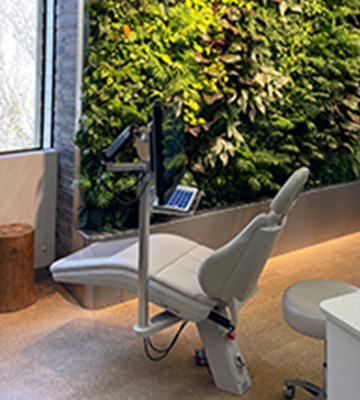
The CBCT Scan: Advanced Airway Diagnostics
Every patient receives a low-dose 3D digital x-ray called a CBCT, or cone-beam computed tomography. This allows us to fully visualize teeth, jaws, jaw joints, and airways in a single scan.
Radiation exposure is extremely low, equivalent to a few days of normal outdoor background radiation. We also use a leaded thyroid shield and equipment that prevents transmission to the reproductive organs.
What We Can See
Tooth Development: impacted or stuck teeth, stage of development, ectopic and ankylosed teeth, genetically missing or extra teeth
Airway and Sinus Health: airway measurements, enlarged adenoids and tonsils, sinus congestion and deviation, nasal turbinate size
Bone and Structure: bone levels, eruption angulation, skeletal balance
Pediatric Sleep Screening
Research shows that approximately 10 percent of children aged 6 to 17 seeking orthodontic care are at high risk for sleep-related breathing disorders. Screening for airway and sleep concerns is a standard part of every pediatric evaluation at Marin Ortho.

Signs we ask about during your child’s consultation:
- Snoring, gasping, or pauses during sleep
- Mouth breathing or unusual sleeping positions
- Excessive nighttime sweating
- Difficulty waking after a full night of sleep
- Daytime fatigue, difficulty concentrating, or hyperactivity
Treatment Options
Palatal Expansion for Children
The ideal time to address airway concerns through expansion is around age 7, after the front adult teeth have come in but before the back adult teeth arrive. Patients with known breathing concerns are encouraged to come in sooner.
For children with a narrow upper jaw or significant airway concerns, a palatal expander with a turnscrew is recommended, widening both the palate and the floor of the nasal cavity. For children with average airway measurements, Invisalign expansion is an excellent alternative.
The EASE Procedure for Teens and Adults
As patients move through puberty, the jaw bones fuse, making traditional expansion more difficult. For teens and adults with airway concerns, we offer the EASE procedure, a minimally invasive surgical approach where a surgeon carefully scores the bones of the upper jaw while the patient is sedated. A distractor is placed during the procedure to gradually widen the jaw over the weeks that follow. Most patients return to normal activity within one to two days. The lower jaw is then widened to match using Invisalign.
What to Expect After Expansion
Speech and swallowing may feel slightly different for the first couple of days. A family member will turn the expander once nightly for approximately six weeks. Lower Invisalign is then added to expand the lower arch, and upper Invisalign closes any front spacing created during the process.
Is an Airway Evaluation Right for You?
We evaluate airway health for every patient. We especially encourage a consultation if:

- Your child snores, mouth breathes, or has been evaluated for sleep apnea
- Your child shows signs of daytime fatigue, difficulty concentrating, or hyperactivity
- You or your child have a narrow palate or constricted airway
- You are an adult experiencing sleep-disordered breathing and want a structural solution